

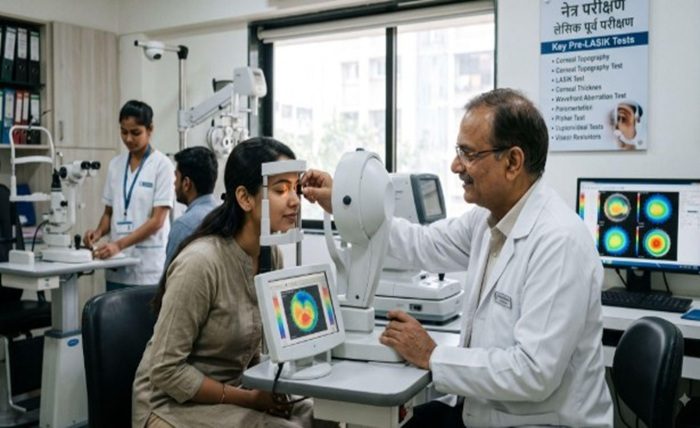
LASIK surgery is not planned based on the glasses prescription alone. Before treatment, the eyes need to be checked to understand whether the cornea is suitable and whether the prescription has remained stable.
A detailed pre-surgery assessment also helps the ophthalmologist decide which laser vision correction method may fit the eye profile.
Why Pre-surgery Screening Matters?
Different eyes can require different treatment approaches. Traditional LASIK, Femto LASIK, PRK, SMILE and other procedures vary in how they reshape the cornea.
This is why an assessment is important before any laser eye surgery. The findings help the ophthalmologist judge eligibility and select an approach based on corneal condition, vision needs and health.
Key Checks before LASIK Surgery
These checks help assess eye suitability and guide the most appropriate LASIK surgery treatment approach.
Corneal Thickness Measurement
Corneal thickness is an important part of LASIK assessment. It is measured through pachymetry. LASIK reshapes corneal tissue, so the ophthalmologist needs to know whether the cornea has adequate thickness for the planned procedure.
If the cornea is thin, a flap-based treatment may not be suitable. In such cases, the doctor may discuss surface-based options such as PRK or EPI LASIK, depending on the examination.
Prescription Stability
The glasses prescription should generally remain stable for at least 12 months before LASIK is considered. A changing prescription can affect treatment planning because the laser correction is based on the refractive error present at the time of surgery.
Reviewing prescription stability helps the ophthalmologist understand whether the eyes are ready for a more permanent correction approach.
Corneal Mapping for Selected Treatments
Some advanced procedures use detailed corneal mapping. For example, topography-guided treatment can measure thousands of points across the corneal surface.
This information helps identify surface irregularities and supports a more personalised correction plan when this technology is used.
General Health and Eligibility Review
Pre-surgery screening considers general health. Uncontrolled diabetes or certain autoimmune conditions may affect eligibility. Pregnancy and breastfeeding are also important considerations, as LASIK is generally not recommended during these periods.
Age is another eligibility factor. Candidates are generally expected to be at least 18 years old, along with having a stable prescription and suitable corneal thickness.
How Test Results Guide the Treatment Choice
The results of these checks help determine whether standard LASIK is appropriate or whether another approach may be better suited. Someone with adequate corneal thickness may be considered for flap-based LASIK, while thinner corneas may lead the ophthalmologist to consider surface-based procedures.
The assessment can also affect discussions around LASIK eye surgery cost. The amount may vary according to the procedure selected, technology used, prescription complexity, surgeon experience and treatment centre.
Final Thoughts
Pre-surgery testing is an essential step in planning LASIK surgery safely and appropriately. Corneal thickness, prescription stability, corneal mapping where required, general health and age all contribute to treatment decisions.
An evaluation by an ophthalmologist helps match the procedure more closely to the individual eye profile instead of choosing treatment based only on convenience or cost.