

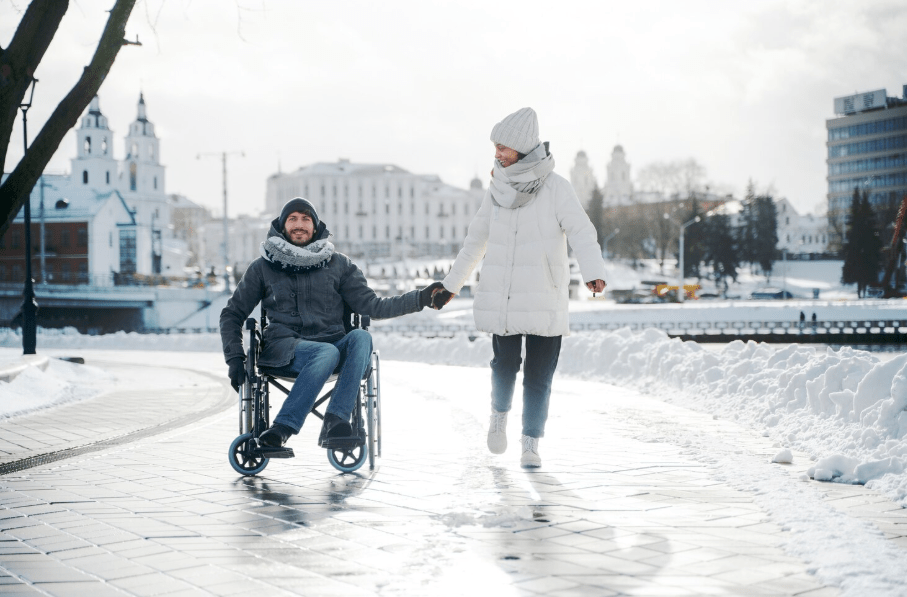
Winter Accessibility Planning for Ramps, Curb Cuts, and High-Traffic Entrances: Clear Is Not Always AccessibleWhen a Clear Path Is Still Not Usable
A winter route can look cleared and still be difficult for someone using a wheelchair, walker, cane, stroller, or other mobility aid. A narrow strip through the snow may work for an able-bodied pedestrian but fail at the first curb cut, ramp landing, or patch of compacted ice.
Snow Removal Expert’s service approach is relevant because accessible winter maintenance requires more than a single plow or shovel pass. Fast snow clearing, modern equipment, 24/7 service, scheduled plans, safety-focused ice control, and repeat inspections become most useful when they preserve a continuous route from parking or drop-off areas to the building entrance.
For facility and healthcare managers, that continuity should be the starting point.
Do not evaluate ramps, sidewalks, doors, and curb transitions separately. Ask whether a person can travel the entire path without encountering a snow ridge, narrowed section, drainage puddle, steep icy cross-slope, or blocked landing.
The route is only as accessible as its most difficult few metres.
Set the Accessible Route Before Winter
Planning Edmonton snow and ice services should begin before snow hides pavement edges, curb transitions, drainage points, and tactile surfaces.
Choose the primary accessible path from designated parking spaces, passenger drop-off areas, transit access, or public sidewalks to the entrance. Then identify alternate routes in case the main path is temporarily affected by maintenance or other site conditions.
Preserve the Usable Width
Snow should be removed across the intended usable width of the route rather than leaving a narrow walking channel.
Edmonton’s accessibility guidance requires curb ramps wherever an exterior barrier-free path encounters a curb and calls for a 1,500-by-1,500-millimetre level surface behind curb ramps in applicable City designs. Alberta guidance also identifies minimum unobstructed dimensions for barrier-free routes and ramps.
Those design figures should not be treated as generic snow-contract specifications for every private property. They do illustrate the operational point: winter maintenance should preserve the space the accessible design was intended to provide.
Protect Grade and Cross-Slope
Snow pushed against one side of a ramp can change how the usable surface feels.
Uneven packed snow may effectively increase cross-slope, reduce manoeuvring space, or force users toward an edge. Clear the surface evenly and pay particular attention to top and bottom landings, turns, handrail areas, and transitions into sidewalks.
The Curb Cut Is Where Snow Becomes a Barrier
Curb cuts frequently become failure points because several snow-removal systems meet there.
A private walkway may be cleared correctly, only for a street plow to leave a ridge across the bottom transition. Parking-lot clearing can push slush toward the same area. Pedestrians and vehicles then compress the remaining snow into a harder obstruction.
That is why a professional snow and ice service plan should treat curb cuts as individual inspection points rather than assuming they are complete because the adjoining sidewalk is clear.
Check the entire transition between sidewalk and roadway or parking surface. Remove ridges rather than creating a narrow notch through them. Keep detectable or tactile areas visible where applicable, and avoid stacking snow where it reduces sightlines between pedestrians and drivers.
High-traffic healthcare, retail, office, and residential entrances may need multiple checks during an event because the curb transition can be blocked again after the contractor’s first visit.
Accessibility maintenance is therefore partly about coordination: what happens to the route after your own crew leaves?
Manage Drainage, Traction, and Entrance Conditions
Snow removal solves accumulation. It does not automatically solve the water and ice that follow it.
Keep Runoff Off the Accessible Path
Ramps and curb cuts are especially vulnerable because they already follow changes in elevation. Meltwater naturally seeks lower areas, and those low points can coincide with the bottom of a ramp or curb transition.
Map nearby roof discharge, downspouts, snow-storage areas, catch basins, and pavement depressions before winter.
Do not place snow where daytime melting sends water across the accessible route. Keep drainage paths open so water does not collect beside a curb cut and refreeze after temperatures fall.
Match Traction Control to the Surface
Traction treatment should respond to actual pavement conditions.
Watch areas where vehicle spray reaches walkways, where foot traffic polishes compacted snow, and where shaded surfaces remain colder than surrounding pavement. Entrances also require attention inside the doorway because tracked snow and meltwater can migrate beyond the exterior route.
The goal is a stable path, not simply a surface that received material.
Inspections should therefore confirm the result after treatment rather than recording application as the end of the task.
Re-Service Before the Route Fails Again
Accessibility routes often need attention sooner than the rest of a property.
A large parking area may remain functional with modest accumulation while a curb cut becomes unusable after a much smaller ridge forms. An entrance may need another ice-control visit while low-traffic areas remain unchanged.
This is particularly relevant when planning winter property service in Edmonton, where persistent cold, continuing snowfall, traffic compaction, and freeze-thaw conditions can change pedestrian surfaces after an initial clearing.
The City of Edmonton reflects the importance of accessible routes in its own winter hierarchy. City-maintained sidewalks and wheelchair ramps adjacent to core facilities and transit locations are included among Priority 1 active pathways, with a bare-pavement service standard targeted within one day after snowfall ends. That municipal standard does not dictate private-property schedules, but it illustrates the value of prioritizing critical pedestrian access rather than treating every surface equally.
Property managers should set their own rapid re-service triggers: renewed snowfall, municipal plow ridges, drifting, visible slush, standing water, falling temperatures, or a reported accessibility obstruction.
Waiting for another general property trigger may be too late.
Build a Seasonal Accessibility Routine
Before winter begins, walk the route as a continuous journey rather than inspecting isolated surfaces.
A practical seasonal review should confirm:
- the primary accessible path and backup route;
- full usable width through ramps and walkways;
- clear curb-cut transitions and landings;
- snow-storage areas away from accessible circulation;
- drainage paths that do not feed meltwater across the route;
- entrance traction and matting requirements;
- inspection points for shaded or repeatedly icy areas;
- rapid re-service and communication procedures.
Document recurring trouble spots during each storm. A ramp that repeatedly receives roof runoff or a curb cut repeatedly blocked by plow windrows should become a known priority for the next event.
Winter accessibility is not achieved by clearing isolated pieces of pavement. It depends on maintaining an uninterrupted path through changing conditions.
For facility, healthcare, and property managers, the better question is not, “Was the sidewalk cleared?”
It is, “Can the person who relies on this route still use the entire route safely and predictably?”
That question produces a much stronger winter plan.