

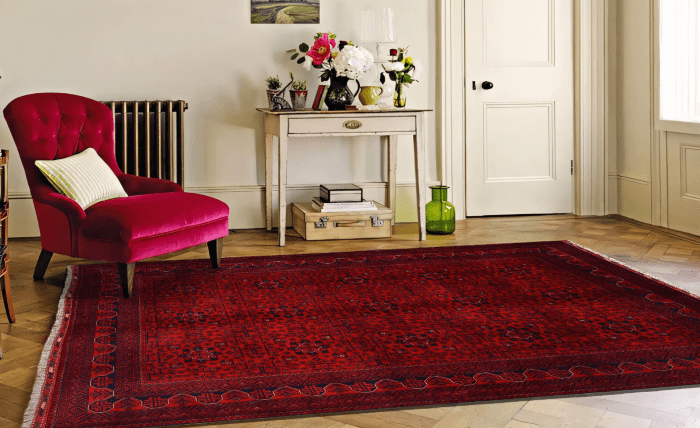
Afghan carpets are among the most recognizable handmade textiles in the world. They stand out for their strong weaving, deep colors, and cultural heritage that reflects centuries of tradition. For generations, they have been used in Afghan homes for daily life as well as traded internationally as valuable works of craftsmanship.
Understanding the history of Afghan carpets also means understanding the communities that produced them. Nomadic tribes, urban workshops, and family-based weaving circles have all contributed to this long-standing tradition. Today, Afghan carpets are both cultural symbols and economic products that connect Afghanistan to global markets.
Early Origins of Afghan Carpets
The roots of Afghan carpet weaving go back to nomadic and tribal communities. Turkmen, Baluch, and Uzbek groups wove carpets for practical use inside tents and for trade. Wool from local sheep provided the material, while natural dyes from plants and minerals gave the carpets their lasting colors.
These early carpets were made for daily living needs. Thick and tightly woven textiles served as flooring, coverings, and insulation during harsh seasons. Because they were built for function first, their strength became one of the defining characteristics of Afghan weaving.
Afghan Carpets in the 19th and 20th Centuries
During the 19th century, Afghan carpets started reaching international markets. Travelers and merchants carried them to Europe, where they were valued for their unique designs. British and Russian influence in Central Asia during this time also helped bring Afghan carpets into global awareness.
In the 20th century, production expanded in cities like Kabul and Herat. Larger carpets were made for export, while smaller tribal pieces continued in villages. Even during years of conflict, Afghan weavers adapted, and carpets known as war rugs appeared. These designs often showed tanks and aircraft, reflecting the realities of war while still using traditional weaving methods.
Regional Styles of Afghan Carpets
Turkmen Afghan carpets are known for the repeated gul motifs, which are geometric medallions across the field of the carpet. These carpets are usually deep red and remain highly recognizable. Halı modelleri
Baluch carpets often use darker tones with tree or lattice patterns. They are smaller in size and usually woven with asymmetrical knots. In contrast, Uzbek and Hazara carpets tend to use brighter colors and sometimes combine weaving with kilim techniques, adding variety to Afghan textile traditions.
Materials and Weaving Techniques
The primary material in Afghan carpets is wool, valued for its durability and softness. Cotton and silk are used in certain pieces, but wool dominates because it is widely available and easy to dye. Afghan wool is especially strong due to the climate and grazing conditions of local sheep.
Dyes traditionally come from natural sources. Red tones from madder root, blue from indigo, and brown from walnut husks have been common for centuries. Although synthetic dyes exist, many rural weavers still use natural methods to achieve long-lasting colors.
Knotting and Looms
Weaving techniques in Afghan rugs often use the Persian knot, also called the asymmetrical knot. Some tribes use the Turkish knot, but it is less common. Knot density varies, but Afghan carpets usually balance durability with detailed designs by using around 50 to 200 knots per square inch.
Two main types of looms are used. Ground looms are more common among nomads, producing smaller pieces, while vertical looms in workshops allow for larger carpets. This difference explains why village carpets often differ in size and proportion compared to urban products.
Common Designs and Patterns
Designs in Afghan carpets are mostly geometric. The gul motif is one of the most widespread, while Baluch carpets show tree designs and prayer rug layouts. Each motif has a connection to the cultural background of the weaver and the intended use of the carpet.
Another popular pattern is the Herati design, a diamond lattice with floral elements. It reflects Persian influence but remains distinct in Afghan weaving. The carpets from northern Afghanistan, known as Khal Mohammadi rugs, stand out with their deep red color and repeating geometric patterns that are uniform and durable.
Cultural and Economic Role of Afghan Carpets
Carpet weaving plays a central role in Afghan society. It provides income for families, especially in rural areas where agriculture alone cannot sustain households. Women are the main weavers, and carpet making is often done at home, making it both a cultural practice and an economic activity.
Afghan carpets also hold cultural value beyond trade. They are used in family ceremonies, religious settings, and as household essentials. In recognition of their importance, organizations such as UNESCO have identified Afghan carpet weaving as part of the country’s intangible cultural heritage.
Modern Developments and Global Market
Today, Afghan carpets are sold worldwide. Export markets in Europe, North America, and the Middle East continue to value them for their handmade quality and strong materials. Modern buyers also look for carpets that combine traditional patterns with updated color schemes.
International programs have supported Afghan carpet production. These efforts include training weavers, improving quality standards, and promoting fair trade. As a result, Afghan carpets not only preserve tradition but also meet modern consumer expectations.
• Traditional Afghan carpets are valued for durability and design.
• Modern Afghan carpets respond to new markets with fresh color combinations.
Conclusion
The history of Afghan carpets reflects both continuity and adaptation. From tribal origins to global trade, they have remained a symbol of Afghan culture and craftsmanship. Their strong wool, natural dyes, and recognizable motifs ensure they remain distinct in the textile world.
As Afghan weavers continue to create carpets for both local use and international markets, the tradition grows stronger. These carpets are not only household items but also cultural artifacts that connect Afghanistan’s past with its present and future.